الوسم: Cybersecurity

  • How to Configure Cloudflare for High-Speed Website Performance, DNS, and DDoS Security

    How to Configure Cloudflare for High-Speed Website Performance, DNS, and DDoS Security

    Learning how to properly configure Cloudflare for website performance and security is vital for modern web applications. In fact, routing traffic through Cloudflare’s global edge network drastically reduces server response times and shields origin servers from volumetric attacks. Furthermore, localized edge nodes across Saudi Arabia ensure sub-millisecond DNS lookups. Therefore, executing a disciplined configuration protocol establishes superior digital resilience.

    Setting Up Authoritative DNS and DNSSEC Protection

    The initial phase of integrating Cloudflare requires delegating nameserver authority from your domain registrar. In fact, Cloudflare provides one of the fastest authoritative DNS infrastructures globally, accelerating initial query resolution for visitors.

    Consequently, update your registrar nameservers and enable DNSSEC (Domain Name System Security Extensions). Cryptographic signing prevents DNS cache poisoning and man-in-the-middle interception across enterprise networks.

    Fine-Tuning Edge Caching and Tiered Caching Rules

    Cloudflare’s true power lies in offloading dynamic traffic away from your origin web server. Configure Cache Everything page rules for static assets, WebP images, and pre-rendered HTML templates.

    In addition, activate Tiered Cache and Early Hints to preload critical resources before browsers request them. These optimizations dramatically reduce Time to First Byte (TTFB) and improve Core Web Vitals metrics across mobile devices.

    Deploying Web Application Firewall (WAF) and DDoS Mitigation

    Malicious bot scrapers and automated vulnerability scans waste origin compute resources and threaten application availability. Therefore, deploy Cloudflare’s managed Web Application Firewall (WAF) to filter malicious payloads automatically.

    Moreover, enforce strict rate limiting on login endpoints and form submission routes to prevent brute-force attacks and spam infiltration.

    Explore our specialized cloud infrastructure and DNS management services. Additionally, discover our high-performance web design and engineering solutions.

    Ultimately, a robust CDN configuration forms the backbone of digital speed. By learning to configure Cloudflare for website infrastructure effectively, organizations achieve world-class security and lightning-fast user experiences.


  • How to Install an SSL Certificate and Enable HTTPS: Fixing Mixed Content and TLS Security

    How to Install an SSL Certificate and Enable HTTPS: Fixing Mixed Content and TLS Security

    Every commercial organization must install an SSL certificate to safeguard user data and maintain search engine trust. In fact, modern web browsers flag unencrypted HTTP websites as insecure, deterring prospective clients and destroying credibility. Furthermore, Google treats HTTPS encryption as a fundamental ranking signal across all competitive queries. Therefore, implementing robust Transport Layer Security (TLS) forms an essential prerequisite for enterprise digital operations.

    Selecting and Generating the Appropriate SSL Certificate

    Security architects must choose an SSL certificate tier aligned with their business requirements. While automated Let’s Encrypt certificates provide robust Domain Validation (DV) for standard websites, commercial enterprises often prefer Organization Validation (OV) or Wildcard certificates.

    Generate a 2048-bit or 4096-bit Certificate Signing Request (CSR) directly on your hosting server. Consequently, submit this CSR to your Certificate Authority to receive the validated certificate bundle, private key, and intermediate CA chain.

    In addition, modern cloud environments allow automated certificate renewal via ACME protocols or managed CDN edge certificates, eliminating the risk of unexpected certificate expiration.

    Configuring Web Servers and Enforcing HTTPS Redirection

    Once the certificate files are installed, configure your web server (Apache, Nginx, or LiteSpeed) to enforce modern cipher suites. Specifically, disable obsolete protocols such as SSLv3, TLS 1.0, and TLS 1.1, restricting encryption exclusively to TLS 1.2 and TLS 1.3.

    Furthermore, implement a permanent server-side 301 redirection rule that forces all incoming HTTP requests to resolve over HTTPS. For instance, in an Apache .htaccess file, verify the HTTPS header and redirect traffic before processing application scripts.

    Moreover, enable HTTP Strict Transport Security (HSTS). This HTTP response header instructs browsers to communicate with your domain exclusively over encrypted channels, mitigating man-in-the-middle downgrade attacks.

    Diagnosing and Resolving Mixed Content Warnings

    A frequent complication following SSL activation is the mixed content error. This warning occurs when an encrypted HTTPS page attempts to load unencrypted HTTP assets—such as images, scripts, stylesheets, or external fonts.

    Consequently, web browsers block passive mixed content or display alarming security warnings in the address bar. To resolve this, run database search-and-replace queries to update all internal asset URLs from http:// to https://.

    Additionally, deploy the Content-Security-Policy: upgrade-insecure-requests response header. This instruction automatically instructs modern browsers to request insecure URLs over HTTPS before throwing console errors.

    Review our specialized cybersecurity coordination and audit readiness services to harden enterprise infrastructure. Furthermore, explore our high-speed cloud web hosting and server solutions.

    In conclusion, protecting web infrastructure requires continuous vigilance. By taking the time to install an SSL certificate correctly, eliminate mixed content, and enforce strict TLS headers, companies can guarantee uncompromised security for their visitors.

  • How to Integrate Saudi Payment Gateways (Mada and Apple Pay): Technical Standards and PCI-DSS

    How to Integrate Saudi Payment Gateways (Mada and Apple Pay): Technical Standards and PCI-DSS

    Successfully integrating Saudi payment gateways is a foundational milestone for any e-commerce enterprise operating in the Kingdom. In fact, local consumers overwhelmingly prefer native payment channels, notably Mada debit cards and Apple Pay, over conventional credit cards. Furthermore, regulatory guidelines set by the Saudi Central Bank (SAMA) require strict security protocols to safeguard electronic transactions. Therefore, implementing certified financial APIs is critical for commercial success.

    Selecting Accredited Payment Providers in Saudi Arabia

    E-commerce architects must select payment gateway providers licensed by SAMA. Leading regional aggregators—including Moyasar, HyperPay, PayTabs, and Geidea—provide direct connectivity to the national Mada payment network.

    When evaluating providers, analyze transaction fee structures, settlement schedules, multi-currency support, and API documentation quality. Furthermore, ensure the provider supports tokenization, recurring subscription billing, and automated webhook event notifications.

    In addition, verify that the gateway provides seamless sandbox environments. Robust sandboxes enable development teams to simulate authorized, declined, and 3D Secure verification flows before touching production funds.

    Integrating Mada and Apple Pay on Mobile and Web

    Integrating Mada requires specialized frontend configuration. Unlike standard Visa or MasterCard processing, Mada debit transactions rely on dedicated routing through the Saudi national payment switch.

    Similarly, activating Apple Pay demands strict domain validation. Developers must register their merchant identifier with Apple Developer, host official domain verification files on an encrypted HTTPS endpoint, and configure merchant certificate chains.

    Furthermore, optimizing mobile checkout UX is vital. Displaying native Apple Pay buttons on product pages and quick-cart drawers eliminates multi-step form entry, dramatically reducing shopping cart abandonment rates among mobile shoppers.

    Satisfying PCI-DSS Compliance and Data Security

    Security governance is paramount when handling financial data. Commercial websites must never store raw cardholder numbers, CVVs, or card expiration dates on internal servers.

    Instead, utilize secure hosted checkout iframes, payment widgets, or direct client-side tokenization. Under this architecture, sensitive card details travel directly from the customer’s browser to the certified gateway, keeping your application within PCI-DSS Self-Assessment Questionnaire (SAQ-A) scope.

    Explore our specialized e-commerce store design and custom development services to build high-converting shopping platforms. In addition, review our digital solutions and pricing packages.

    In summary, modern digital commerce requires frictionless, secure payment processing. By integrating certified Saudi payment gateways correctly, enterprises can cultivate consumer trust, boost conversion rates, and build sustainable revenue streams.

  • Mobile App & Web Application Security in KSA | Alkhowatir

    Mobile App & Web Application Security in KSA | Alkhowatir

    Hardening mobile app & web application security is an urgent operational imperative for any Saudi business processing corporate records, customer data, and electronic payments. In fact, overlooking application security exposes enterprises to devastating data breaches, regulatory penalties, and lasting reputational damage. Therefore, robust security practices must be engineered into every layer of software development from initial architecture through deployment.

    Core Defensive Measures for Modern Digital Platforms

    • End-to-End Cryptography (TLS 1.3 & AES-256): Ensuring all data in transit and at rest remains fully encrypted against interception.
    • API Hardening & Multi-Factor Authentication: Implementing token-based authentication and rate limiting to neutralize automated attacks.
    • Regular Penetration Testing: Identifying code-level vulnerabilities in accordance with essential cybersecurity controls formulated by the National Cybersecurity Authority (NCA).
    • Least-Privilege Access Controls: Restricting administrative permissions to verified employees based strictly on functional necessity.

    Discover our specialized cybersecurity coordination and audit readiness solutions for Saudi enterprises.

  • Aramco & SABIC Contractor IT Readiness: How to Pass Cybersecurity Audits Seamlessly

    Aramco & SABIC Contractor IT Readiness: How to Pass Cybersecurity Audits Seamlessly

    Achieving Aramco contractor IT readiness is now a mandatory milestone for industrial suppliers across the Kingdom of Saudi Arabia. Therefore, compliance with the Third Party Cybersecurity Standard (SACS-002) is essential to qualify for major energy contracts.

    Comprehensive Aramco contractor IT readiness framework for Saudi industrial vendors

    Why Aramco Contractor IT Readiness Dictates Procurement Success

    Modern industrial supply chains operate in deeply interconnected digital environments. Consequently, energy operators view contractor workstations and cloud services as critical extensions of their own perimeter. Furthermore, an unpatched vulnerability in vendor systems could jeopardize vital energy infrastructure. As a result, procurement officers rigorously inspect cybersecurity compliance before awarding major tenders.

    The Four Pillars of Contractor Cybersecurity Compliance

    1. Multi-Factor Authentication and Network Segregation

    Enterprise guidelines require multi-factor authentication across all remote access portals and administrative tools. In addition, sensitive project networks must remain strictly isolated from public office Wi-Fi. Therefore, unauthorized lateral movement is prevented throughout the corporate infrastructure.

    2. Domain-Authenticated Corporate Communications

    Procurement departments routinely disqualify bids submitted through generic public webmail services. Consequently, contractors must implement domain-branded corporate email backed by strict SPF, DKIM, and DMARC enforcement. Moreover, authenticated communication protects commercial invoices from sophisticated email spoofing attacks.

    3. Endpoint Detection and Vulnerability Hygiene

    Every operational device must maintain managed Endpoint Detection and Response software. In addition, IT managers must document systematic patch management cycles consistent with national guidance from the National Cybersecurity Authority (NCA). Consequently, critical operating system vulnerabilities are resolved before audits begin.

    4. Air-Gapped Backups and Disaster Recovery Drills

    Contractors must maintain regular, encrypted backups of critical project data. Furthermore, preserving an immutable copy disconnected from the primary network defends against modern ransomware threats. As a result, businesses can recover quickly without catastrophic operational downtime.

    Securing Long-Term Vendor Prequalification

    Achieving full compliance requires proactive preparation and structured technical remediation. Therefore, running a pre-audit gap assessment accelerates formal approval while preventing expensive bid disqualifications. Ultimately, proven Aramco contractor IT readiness builds enduring trust with major industrial operators across Jubail, Dammam, and Al Khobar.

    The team at Alkhowatir Al-Jazira delivers specialized guidance through our contractor readiness services and cybersecurity coordination solutions for Aramco and SABIC contractors in the Eastern Province. Contact us today to schedule a technical readiness consultation.

  • Official Corporate Email with Custom Domain: Essential Security and Brand Trust Guide

    Official Corporate Email with Custom Domain: Essential Security and Brand Trust Guide

    Deploying an official corporate email connected directly to your proprietary company domain is a non-negotiable standard for professional commerce. In fact, conducting enterprise business using generic free webmail accounts undermines customer confidence and exposes your organization to severe security vulnerabilities. Furthermore, government entities and corporate procurement departments in Saudi Arabia mandate secure communication channels. Therefore, establishing enterprise email infrastructure is fundamental to institutional credibility.

    Strengthening Brand Credibility and Customer Trust

    First and foremost, your email address is often the first point of formal contact with prospective clients, investors, and regulators. When employees correspond from branded domain addresses (such as name@company.com.sa), recipients instantly verify their legitimate organizational authority.

    Consequently, institutional trust increases dramatically. In contrast, utilizing public email providers signals operational amateurism and elevates spam filtering scrutiny across enterprise mail servers.

    Enterprise Security, Encryption, and Phishing Defense

    Corporate communication frequently involves sensitive financial transactions, legal contracts, and intellectual property. Therefore, an official corporate email suite provides robust administrative defenses against data breaches.

    Specifically, enterprise platforms enforce modern authentication protocols, including SPF, DKIM, and DMARC verification records. These cryptographic standards prevent malicious actors from spoofing your domain name to execute phishing scams or payment diversion attacks.

    Centralized Administration and Regulatory Compliance

    When employees depart an organization, retaining custody of commercial communications and customer relationships is essential. Centralized administrative consoles enable IT directors to revoke account access, archive correspondence, and enforce data loss prevention (DLP) policies effortlessly.

    Moreover, enterprise email configurations assist businesses in complying with National Cybersecurity Authority (NCA) essential controls and Saudi Personal Data Protection regulations.

    Review our specialized Saudi domain registration and official email hosting services. In addition, explore our enterprise bilingual corporate web development solutions.

    Ultimately, professional communication infrastructure safeguards your enterprise reputation. By implementing official corporate email across your workforce, your organization projects authority, protects proprietary data, and accelerates business growth.

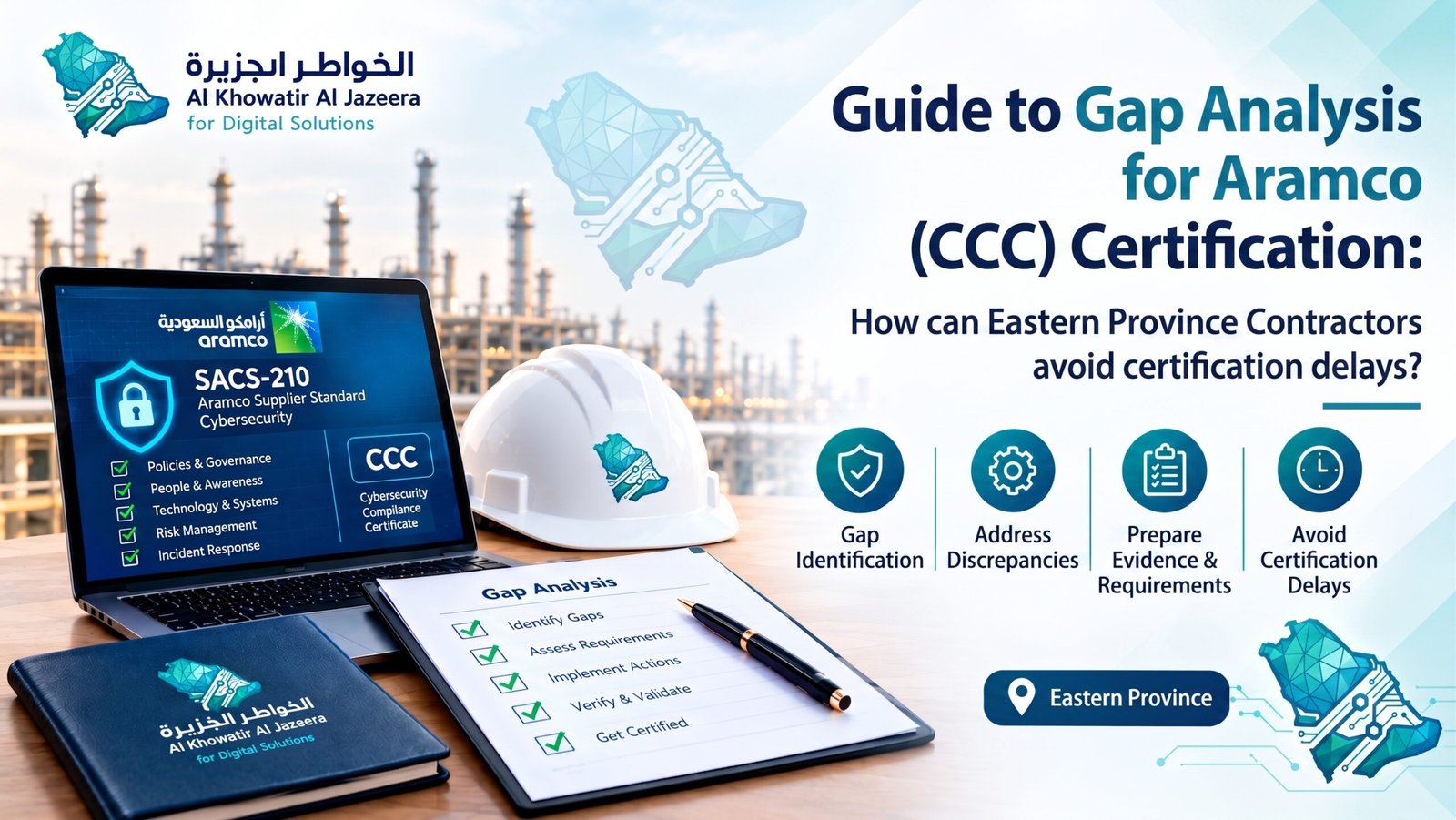
  • Aramco CCC Gap Analysis Guide: How Eastern Province Contractors Avoid Audit Delays

    Aramco CCC Gap Analysis Guide: How Eastern Province Contractors Avoid Audit Delays

    In the Eastern Province—specifically across Jubail, Dammam, and Khobar—securing the Aramco Cybersecurity Compliance Certificate (CCC) is an absolute operational requirement. Consequently, valid certification is mandatory to bid on contracts and participate in major energy projects.

    Under the revised SACS-210 standard, audit requirements have become substantially more stringent. Therefore, attempting an audit without rigorous gap analysis frequently leads to costly delays. In addition, failed assessments can disrupt ongoing operations for months.

    1. What Is an Aramco SACS-210 Gap Analysis?

    A gap analysis is an exhaustive diagnostic review comparing your existing security controls against Aramco’s framework. As a result, this evaluation uncovers technical vulnerabilities before external auditors arrive. Furthermore, early detection provides ample time to rectify deficiencies calmly and systematically.

    2. Why Contractors Fail Initial Audits

    Field experience shows that audit delays stem from predictable technical oversights. For example, missing documented evidence and unverified system logs represent the most frequent audit findings.

    Moreover, inadequate access controls and weak encryption policies trigger immediate non-compliance notices. In contrast, accredited third-party evaluators require concrete proof of daily technical enforcement.

    3. Practical Methodology for Compliance

    Achieving SACS-210 certification requires a disciplined four-stage implementation strategy:

    • Step 1 (Scoping): Accurately inventory every workstation, server, and network device connecting to Aramco data. Specifically, incorrect scoping causes the majority of assessment delays.
    • Step 2 (Control Assessment): Review firewall configurations, endpoint protection, and encryption protocols. In addition, ensure your organization utilizes secure official domain email architecture.
    • Step 3 (Evidence Collection): Gather genuine audit logs and automated vulnerability scan reports. Consequently, the credibility of your documentation determines your assessment score.
    • Step 4 (Remediation Plan): Formulate an actionable roadmap to address identified gaps before scheduled third-party auditing.

    4. Strengthening Commercial E-E-A-T and Market Trust

    In B2B industrial contracting, cybersecurity compliance functions as a powerful trust accelerator. Therefore, certified contractors enjoy distinct competitive advantages during major vendor selections.

    Ultimately, verified compliance demonstrates proven operational resilience. As a result, your organization establishes itself as a preferred supplier for top-tier energy operators.